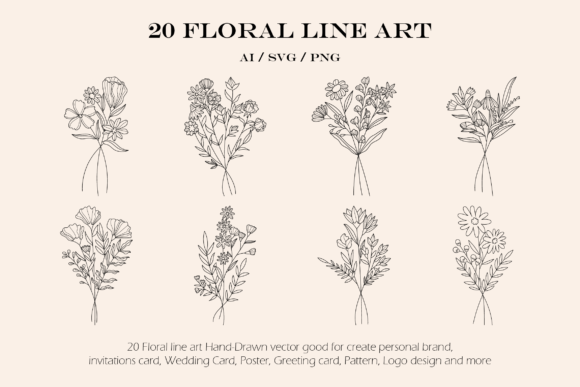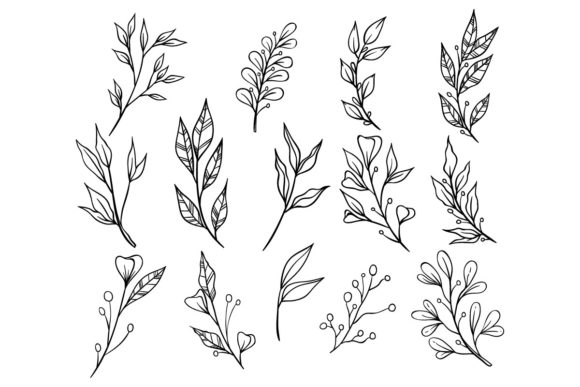
Flower Sketch Vector & Floral Outline Art Inspiration
At first glance, a line drawing of a petal might seem simple. Yet when that sketch becomes a Flower Sketch Vector, it carries a quiet power. You can stretch it to billboard size, weave it into an animation, or carve it into a logo—and it stays razor sharp. For designers, marketers, and makers, Floral Outline Art is one of those rare resources that balances organic warmth with technical precision. It feels hand-drawn and human, but behaves like the cleanest digital asset you own.
What makes this format so practical is not just beauty, but structure. The files are openable, editable, and resizable without losing quality. Adobe Illustrator and Corel Draw read them natively, and layers are already well organized. Whether you are building a brand identity, teaching a workshop, or refreshing a blog header, you don't waste time cleaning up messy anchor points. You open the file and start creating.
What Makes a Flower Sketch Vector Different
A raster image of a floral drawing locks you into one resolution. Zoom in, and petals become stair-stepped pixels. A Flower Sketch Vector works differently. Every curve, leaf vein, and stem is defined by mathematical paths. That means you can resize the same daisy outline from a favicon to a storefront mural without ever losing crispness. For a small business owner printing on tote bags and mugs, that reliability removes a layer of technical anxiety.
The charm of Floral Outline Art sits in its restraint. Unlike heavily shaded botanical illustrations, outline vectors often use minimal line weight. This negative space invites color fills, texture overlays, and even animation rigging. Many creators treat them as a backbone rather than a finished piece—a skeleton you can dress for different seasons, campaigns, or moods.
File organization matters here. Templates tagged with “layer well organized” or “easy to edit” typically arrive with groups for petals, leaves, centers, and background elements already separated. In Adobe Illustrator, you can isolate a single bloom, change its stroke width, or recolor it in seconds. Corel Draw users find the same flexibility. It respects your time.
Creative Possibilities Beyond the Obvious
A rose sketch vector doesn’t have to stay a rose. One outline asset can spin into dozens of outputs. Here are some directions that push the idea further:
- Monochromatic Branding Systems: Pick one flower outline as the core mark. Repeat it across packaging, social icons, and email signatures. Vary only the negative space color. The consistent silhouette builds recognition faster than a complex logo.
- Layered Stencil Effects: Combine two or three Floral Outline Art elements, offset slightly, and assign each a low-opacity pastel. The result mimics a screen-printed layering technique, perfect for apparel mockups or album art.
- Animated Bloom Cycles: Vector outlines import cleanly into After Effects or Lottie workflows. You can animate a stroke-dash offset to simulate a flower drawing itself onto the screen—ideal for explainer videos or app loading screens.
- Educational Diagram Overlays: Teachers and science communicators often need accurate but simple botanical forms. Editable vector flowers let you label parts, enlarge pistils, or create matching exercises without hiring an illustrator each time.
There is a common worry that using templates stifles originality. The opposite is often true. When you don't struggle with proportion or bezier curve fundamentals, you can spend more energy on concept, composition, and emotional tone. The Flower Sketch Vector becomes a starting block, not the whole construction.
Choosing the Right Format for Your Workflow
Not all vector files are equal, and knowing which format to grab saves friction. The typical download bundle—Fully Editable Template JPEG, EPS, and Ai Adobe Illustrator File—gives you three different strengths:
- AI (Adobe Illustrator): Native file with layers intact. Ideal if you need to deeply edit individual petals, change stroke profiles, or export to other Adobe apps. Layers are usually named logically (“leaves,” “buds,” “floral wreath”), which is critical when you hand off to a teammate.
- EPS: A universal exchange format. Corel Draw, Affinity Designer, and even some cutting machine software (like Silhouette Studio or Cricut Design Space) read EPS reliably. When you don't know the recipient’s tool, EPS is the safe choice.
- JPEG Preview: Not a working file, but a quick reference. Useful for clients who need to approve a composition before you invest hours. The JPEG shows the final look, while the AI or EPS holds the real editability.
Organization within these files is not an afterthought. A well-structured template groups similar elements, locks background layers, and uses global swatches. Changing the base color from dusty rose to sage green across an entire bouquet can happen with one edit. If you’ve ever spent an afternoon hunting for an ungrouped leaf in a sea of thousand paths, you’ll appreciate the difference.
Design Project Ideas That Fit Real Timelines
The beauty of Floral Outline Art lies in how quickly you can adapt it to a brief. Here are several practical projects—none taking more than an afternoon, all delivering professional polish:
- Wedding Invitation Suite: Grab a delicate fern and peony vector outline. Apply a single metallic gold stroke, pair with a minimal serif font, and output place cards, menus, and RSVP cards. The consistency from herb to font is what makes it feel custom.
- Instagram Story Templates: Use the flower as a subtle frame. Reduce opacity to 10%, place behind text. The organic shape softens the edge without stealing attention. Save as an Adobe Illustrator template, then swap colors per brand palette.
- Small Business Merch: A coffee shop wants a tote bag design. Scale a chamomile sketch vector to fill the canvas, convert strokes to outlines, and send to print. Because it’s vector, the file works for mugs, hats, and window decals without re-creation.
- Motion Graphic Intro: Animate three outline flowers in sequence using trim paths in After Effects. The hand-sketched feel contrasts beautifully with modern sans-serif titles, making your intro memorable but not busy.
- Coloring Book Pages for Adults: Outline art is essentially a ready-made coloring page. Thicken the strokes slightly, arrange multiple flowers into a mandala on an A4 artboard, and publish as a printable PDF. A single vector asset becomes a whole product line.
These project ideas share a core principle: treat the vector as raw material. The shape is given, but color, scale, arrangement, and medium are yours. That mindset prevents the “template look” and keeps work feeling personal.
Adapting Floral Outlines for Different Audiences
Your audience always dictates how bold or delicate your linework should be. A Gen Z streetwear brand might want aggressive, high-contrast daisy outlines set against neon blobs. A wellness coach might need same flowers but with thin, airy strokes and soft earth tones. The Flower Sketch Vector doesn’t lock you into one personality.
Consider these adaptation layers:
- Stroke weight: Increase to 3pt for a playful, almost marker-like look. Reduce to 0.5pt for an elegant, engraving-style finish.
- Color palette: Use one flower in three different colorways to test which gets more saves on Pinterest. Outline art makes this A/B test trivial.
- Cultural context: Lotus, chrysanthemum, and hibiscus carry different meanings. Having a generic but editable petal shape lets you suggest a specific bloom without needing botanical accuracy.
- Accessibility: Outlines naturally offer good contrast. When placing text over a flower background, lighten the outline to near-white so that message stays readable. Vector control gives you that nuance.
Freelancers often keep a folder of reliable Floral Outline Art vectors and treat them like a seasoning, not the main ingredient. A website hero section might use one large magnolia sketch offset behind the headline. The outline creates movement without competing. That subtlety works across industries because it doesn’t demand attention; it earns it.
From Sketch to Scalable Vector: A Seamless Workflow
While you can always draw your own and auto-trace, using pre-made vector files accelerates projects where speed and consistency matter. The included AI and EPS files are typically created by illustrators who already optimized anchor counts. Fewer points mean smaller file sizes, faster rendering in After Effects, and easier path manipulation in cutting machines.
For those incorporating these assets into laser cutting, CNC routing, or vinyl plotting, the outline must be continuous and clean. Gaps or overlapping paths cause the machine to misfire. Well-organized Flower Sketch Vector files often pass that test immediately because they were built for digital crafters, not just screen viewing.
When you open the file in Adobe Illustrator, the layers panel reveals the designer’s logic. You might see a folder for “Background Outlines,” one for “Detail Lines,” and another for “Fill Guides.” Understanding this structure helps you customize without breaking the artwork. In Corel Draw, the same logic persists via grouped objects and named layers. The learning curve is shallow, and once you know the pattern, you can modify any floral asset in your library the same way.
Keeping Results Clear, Organized, and Audience-Friendly
Even with beautifully editable vectors, clutter creeps in fast. A designer may end up with 37 open flower variations littering an artboard. A few habits make the difference:
- Use global color swatches early. Assign a “Petal Stroke” swatch to all floral outlines. Later, if the client requests a burgundy instead of black, you change one swatch and everything updates. This quickness encourages experimentation because revising feels free, not tedious.
- Name layers with purpose. “Layer 12 copy 3” helps no one. Rename to “Left floral cluster,” “Central amaryllis,” even when you are deep in flow. It saves you the next morning when you need to hand off the file.
- Create style guides from vectors. Pull the hex codes, stroke widths, and font pairings into a one-page document. The flower sketch becomes the anchor of a repeatable visual system, not a one-off decoration.
- Test across formats. Export the same flower composition as SVG for the web, PDF for print, and DXF for a laser. Check that strokes remain uniform. Sometimes programs interpret strokes differently; converting to outlines before final export prevents surprises.
These practices don’t just protect the file; they protect the creative momentum. When you know every petal can be recolored, rearranged, and repurposed without degrading, you take more risks in the design itself.
The Human Element of Outline Art
There’s a reason floral motifs never really leave visual culture. They signal growth, fragility, and resilience all at once. A Floral Outline Art vector, with its imperfect-looking yet mathematically perfect curves, captures that paradox. It’s precise without feeling sterile. For bloggers designing a new course badge, an entrepreneur refreshing a podcast cover, or a hobbyist making a personal sticker sheet, this balance matters. You’re not just adding flowers; you’re adding a sense of care.
In a landscape where many digital assets feel synthetic, outline vectors retain a sketchbook sincerity. The slight irregularity of a hand-drawn petal, preserved in a perfectly scalable path, gives a project groundedness. Use that to your advantage. Let the outline breathe. Don’t over-embellish. Often a single stem placed off-center says more than a dense bouquet.
As you explore new uses for Flower Sketch Vector and Floral Outline Art, remember that the best design tool is the one that gets out of your way. These files—openable, editable, resizable, and layered with care—are built for that. Keep them in your asset library, credit where you can, and let the lines do what lines do best: hold space for your ideas.