The Universal Canvas: Unlocking Creativity with Floral Line Art Vector Illustrations
In the world of digital design and creative projects, a single file type can make the difference between a rigid, frustrating process and a fluid, empowering one. When you discover a beautiful floral line art design, the first question is often: "How can I use it?" The answer lies not just in the artwork itself, but in the format it comes in. A collection of Floral Line Art Vector Illustration files, provided in openable, editable, and resizable formats like AI, EPS, SVG, DXF, and PNG, represents a key to a vast kingdom of creative possibility. This article explores the foundational importance of vector graphics, the specific versatility of floral line art, and the practical magic of having these designs in truly usable vector formats.
Understanding the Core: What is a Vector Illustration?
Before diving into the floral patterns, it's essential to grasp the engine behind them: the vector format. Unlike a standard photograph or a PNG, which is made of a fixed grid of pixels, a vector illustration is built from mathematical paths, points, lines, curves, and shapes. Think of it as a set of instructions rather than a finished picture. This fundamental technical difference is what grants its legendary superpowers: openability in professional programs like Adobe Illustrator, editability of every single element, and resizability to any dimension without any loss of quality—from a tiny sticker to a massive banner.
This "infinitely scalable" nature is a common point of misunderstanding. Many assume a high-resolution PNG is enough, but scaling a PNG up leads to blurry, pixelated edges. A vector file, however, recalculates its paths cleanly, ensuring crisp lines at any size. When you receive a floral design in true vector formats (AI, EPS, SVG), you are receiving the blueprint, not just a snapshot. This puts you in the designer's seat, with full control to adapt the artwork to your exact needs.
The Allure of Florals: Why Line Art is a Timeless Choice
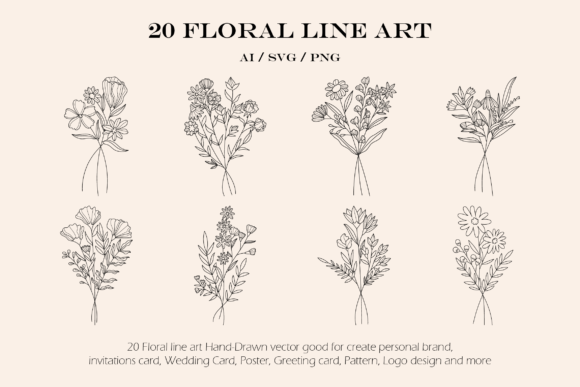
Floral line art vector illustration occupies a special niche. It strips away color and shading to focus on the essential form—the elegant curve of a petal, the intricate weave of a leaf, the delicate connection of stems. This minimalism is its strength. Line art is inherently versatile; it serves as a perfect base layer. It can be left as a stark, modern black-and-white graphic, filled with vibrant colors, textured with backgrounds, or combined with other elements. Floral motifs themselves are universally resonant, symbolizing nature, growth, beauty, and celebration, making them suitable for an incredibly wide range of applications and audiences.
Furthermore, the clean lines of vector florals are not just aesthetically pleasing; they are practically superior for many production techniques. Sharp, defined paths are exactly what cutting machines, engraving tools, and printing screens need to follow precisely. A blurry or complex shaded image can cause technical hiccups, whereas a crisp vector line translates flawlessly into physical products.
The Format Toolkit: What Each File Type Offers You
When you acquire a bundle offering multiple formats, each serves a strategic purpose. Here’s a breakdown of how these vector files work for you:
- AI (Adobe Illustrator Native File): This is the gold standard for full editability. Opening an AI file in Illustrator gives you direct access to every anchor point and path. You can change stroke weights, delete elements, add new ones, or rearrange the entire composition. It’s the master file for professional customization.
- EPS (Encapsulated PostScript): A legacy but highly reliable vector format readable by many older and diverse software packages, including many professional printing and cutting systems. It ensures compatibility across a broad ecosystem.
- SVG (Scalable Vector Graphics): The web-friendly vector standard. SVG files are perfect for digital use—they can be embedded directly in websites, used in web-based design software, or imported into digital presentation tools. They scale perfectly on any screen.
- DXF (Drawing Exchange Format): A specialized format crucial for the world of computer-controlled fabrication. Many cut machines (like those for vinyl, paper, or fabric) and engraving software platforms use DXF as their primary input. This format translates the floral lines into precise cutting or engraving instructions.
- PNG (Portable Network Graphics): While not a vector format, a high-quality PNG is included as a ready-to-use raster image. It’s ideal for quick placements in simple software, online listings, or social media previews. However, remember it cannot be resized or edited like its vector companions.
This multi-format approach removes technical barriers. Whether you are a hobbyist with a cutting machine at home, a small business owner using online design tools, or a professional graphic designer in Illustrator, you have a file that works seamlessly with your setup.
The Practical Universe: Applications in Modern Creativity and Business
The true measure of these resources is in their application. Possessing an editable floral vector file transforms it from a static image into a dynamic creative asset. Its relevance spans personal projects, entrepreneurial ventures, educational activities, and technological hobbies.
For Personal Creativity and Custom Gifts
Imagine personalizing a wedding invitation, a birthday card, or a holiday decoration. With the vector file, you can easily edit the design—perhaps simplify it, combine two floral elements, or add text directly intertwining with the stems. You can then output it for printable decoration, use it as an iron-on transfer for a unique T-shirt, or send the SVG to a service to produce a custom engraved necklace. The personal touch comes from your ability to modify, not just select.
For Small Business and Merchandise Production
For anyone in the realm of print-on-demand or custom merchandise, these files are a production powerhouse. The same single floral vector design can be resized appropriately for a mugs printing template, a T-Shirts Printing layout, a bags design, and a small stickers die-cut template. Because it's vector, you ensure print quality is sharp on all items, regardless of their size difference. Furthermore, you can quickly tailor the design to different collections or seasons by changing colors or compositions within the vector software, creating a cohesive brand look from one source asset.
For Education and Skill Development
For students or beginners learning graphic design, a well-constructed floral vector file is an excellent learning tool. Opening it in Illustrator allows them to deconstruct how professional illustrations are built—seeing how complex curves are achieved with simple paths. They can practice editing strokes, experimenting with fills, and understanding layer management, all on a beautiful, motivating template.
For Technology Integration: CNC, Cutting, and Engraving
The intersection of digital design and physical fabrication is a growing area. Floral line art in DXF or SVG format is directly usable in software for laser cutters, CNC routers, and vinyl cutters (like Cricut or Silhouette projects). This means a digital design of a rose can become a wooden sign, an engraved glass, a delicate paper cutout, or a fabric appliqué with perfect precision. The line art’s clarity ensures the machine’s tool follows the design exactly as intended.
Building a Broader Understanding: Key Considerations and Best Practices
To leverage these files fully, a few guiding principles help. First, always start with the vector master file (AI or EPS) for any editing. Make your changes there, then export the result to the specific format (like PNG for web or DXF for cutting) you need for the final application. This preserves quality throughout the workflow.
Second, recognize that the editable nature invites experimentation. Don't feel confined to the original layout. Perhaps extract a single flower from a bouquet to use as a repeating pattern. Or reverse the line art (make a white line on a dark fill) for a different visual effect on dark garment fabrics.
Finally, a common assumption is that vector files are only for experts. While the AI file requires Illustrator, the SVG and PNG formats are broadly accessible in simpler, free software online. Many web-based design platforms now support SVG import, making professional-grade scalability available to everyone. The bundle format approach democratizes high-quality design.
In conclusion, a Floral Line Art Vector Illustration package delivered in multiple, genuine vector formats is more than just a collection of images. It is a transfer of creative authority. It empowers you to adapt, scale, and apply a timeless aesthetic motif across the vast landscape of modern making—from digital screens to physical products, from personal crafts to commercial goods. By understanding the "why" behind the vector formats and the "how" of their application, you unlock a resource that is not only beautiful but fundamentally functional, fitting seamlessly into your creative life, work, and technological endeavors.