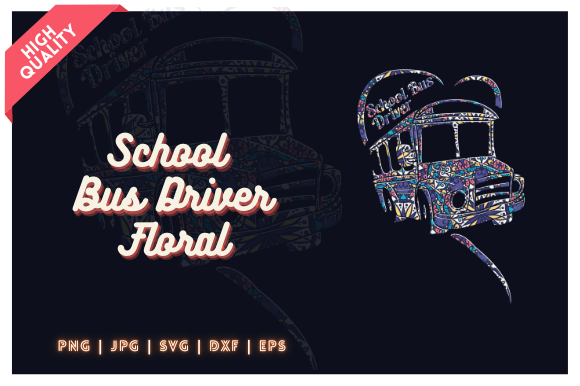
The School Bus Driver Floral Design: From Digital File to Creative Expression
In the vast landscape of digital art and craft, a specific category of products bridges the gap between professional graphic design and everyday creative projects. These are ready-made, fully editable vector designs like the "School Bus Driver Floral" collection. This article explores this fascinating niche, explaining not just what these files are, but their purpose, significance, and how they empower creativity in modern life, business, and personal expression.
Understanding the Digital Product: A Bundle of Possibilities
When you encounter a listing for a design like "School Bus Driver Floral," offering a DXF, EPS, SVG, JPG, and PNG file in a ZIP folder, it represents a complete digital toolkit. This is not a single static image but a multifaceted resource. Each file format serves a distinct purpose in the world of digital creation and manufacturing.
The core of the product is the vector file—typically the EPS and SVG formats. Vector graphics are not made of pixels but of mathematical paths and points. This means they are "fully editable" and "resizable" without any loss of quality. The description "Made with 100 vector shapes" indicates a complex, layered design where each element, like a flower petal or a bus detail, is a separate, manipulable shape. You can change colors, rearrange components, or scale the entire design from a postage stamp to a billboard poster, all while maintaining crisp, clean lines.
The Purpose and Significance of Multi-Format Files
Why provide five different files? Each format targets different software and end uses, maximizing the product's practical relevance.
- DXF (Drawing Exchange Format): Primarily used in computer-aided design (CAD) and, crucially, with CNC machines. This file allows the design to be used for precise cutting, engraving, or routing on materials like wood, metal, or acrylic. It's the gateway to physical fabrication.
- EPS & SVG (Encapsulated PostScript & Scalable Vector Graphics): These are the standard for professional graphic design software like Adobe Illustrator or CorelDRAW. They allow deep editing and are ideal for preparing the design for print or further digital integration.
- JPG & PNG (Raster Images): These are pixel-based, ready-to-use images. The high-quality 300 DPI JPG is perfect for standard printing applications. The PNG often includes a transparent background, making it easy to overlay the design onto different colored materials or digital layouts without a white box around it.
This bundle approach democratizes design. It means that whether you are a hobbyist with basic software, a small business owner with a CNC router, or a graphic designer, you have a file you can work with.
Fitting into Modern Creative and Commercial Life
The listed "perfect for uses"—T-shirts, mugs, bags, posters, card making, hoodies—highlight how this digital asset fits into contemporary maker culture and small-scale entrepreneurship. The "School Bus Driver Floral" theme itself is a great example: it caters to a specific, appreciative community—school staff, parents, or bus enthusiasts—and provides a ready-made, professional design that celebrates that role with a stylish, floral aesthetic.
Empowering Small Businesses and Personal Projects
For a small business selling customized merchandise, such a design package eliminates the need for expensive, upfront graphic design work. They can purchase the license, edit the vector files to perhaps add a school name or adjust the color scheme, and then use the appropriate format to produce goods. The DXF file allows a workshop to laser-engrave the design onto a commemorative plaque. The PNG file lets a print-on-demand service create a transparent overlay for a website product mock-up.
For individuals, it enables high-level personal expression without requiring advanced artistic skills. A parent could use the PNG to create a unique birthday card for a beloved bus driver. A craft enthusiast could use the SVG with a home cutting machine to create a decorative vinyl decal. This accessibility is a key part of its significance.
Clarifying Common Misunderstandings
Several points in the product description directly address common assumptions in the digital marketplace.
- "DIGITAL download and NO physical items will be shipped": This clarifies that the customer is buying the intellectual property—the files—not a finished physical product. The value is in the utility and license of the design itself.
- "Files are compressed in one ZIP File": This is a standard practice for delivering multiple files. It's a simple technical step, but noting it helps beginners understand they'll need extraction software like 7-ZIP or WinRAR.
- The Strict License: "The ACTUAL FILES may NOT be shared or resold in any form": This is a critical point of ethics and legality. The buyer purchases a license to use the design for their projects or end products, but they cannot redistribute the source files themselves as a commercial product. This protects the original designer's work and is a standard practice in digital asset marketplaces.
The Role of Quality and Resolution
The note about "High quality with 300 dpi" for the JPG/PNG files speaks to a common concern: print readiness. DPI (dots per inch) is a measure of print resolution. 300 DPI is the standard for high-quality photographic or graphic printing, ensuring that when the raster image is printed on a mug or poster, it appears sharp and detailed, not blurry or pixelated. This specification assures customers of professional-grade output.
Building a Broader Understanding: The Ecosystem of Digital Designs
The "School Bus Driver Floral" package is one node in a vast ecosystem. Similar designs exist for countless themes—animals, professions, holidays, abstract patterns. This model supports a global creative economy. Designers create and sell their vector work; makers and businesses purchase and implement it. It fuels niche markets, allows for rapid customization, and supports the trend towards personalized goods.
From a technological perspective, it showcases how different file formats act as interoperability bridges between creative software (Illustrator), manufacturing hardware (CNC machines), and print services. Understanding this flow—from an editable vector on a screen to a physical, embroidered logo on a sweater—is key to appreciating its practical relevance.
Educational and Community Applications
Even in education, such resources have a place. A teacher in a graphic design class might use such a multi-format bundle to teach students about the differences between vector and raster files, or how to prepare artwork for different outputs. The specific, relatable theme makes the technical lesson more engaging. Furthermore, designs celebrating specific roles, like a school bus driver, can be used to create appreciation gifts within a school community, fostering a positive culture.
In conclusion, a product like the "School Bus Driver Floral" digital download is far more than just a picture. It is a versatile, professional-grade creative asset that lowers the barrier to high-quality design work. It serves as a tool for entrepreneurship, a medium for personal crafting, and an example of how digital technology translates into tangible, meaningful objects. By providing the design in its foundational vector forms alongside ready-to-use raster images and machine-ready CAD files, it empowers users across different skill levels and technical setups to participate in creation, celebration, and commerce. Understanding the purpose and proper use of each file format unlocks the full potential of such digital toolkits, turning a downloaded ZIP folder into a world of creative possibilities.